Reminiscences of a Stock Operator: Free Ebook & Summary (2026)
By TopFreeBooks · Published · Updated · 8 min read
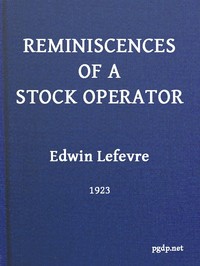
Reminiscences of a Stock Operator is the trading classic people keep recommending, and you do not need to buy it. Edwin Lefèvre published it in 1923, and the original text is in the public domain in the USA, so Project Gutenberg gives it away free. Below: where to get the free copy, what the book is about, the eight lessons it is best known for (with the exact lines from the book), and four more free classics to read after it.
Key facts
Book
Reminiscences of a Stock Operator, by Edwin Lefèvre
First published
1923
Free source
Project Gutenberg #60979 (no signup)
Formats
EPUB, Kindle, HTML, plain text
Length
24 chapters, about 109,000 words
Licence
Public domain in the USA (check your country)
How we checked these are free and legal
On 28 October 2026 we opened the Project Gutenberg page for the book (#60979), confirmed it is marked "Public domain in the USA" and that the EPUB and Kindle files download, and read the Gutenberg text to check every quote and date below. We also opened the official page of each "read next" book. We link only to those sources, never to unofficial PDF copies.
Is Reminiscences of a Stock Operator free and legal to download?
What is not free is newer material. The annotated edition Wiley published in 2009, with notes on the real people behind the story and a foreword by hedge fund manager Paul Tudor Jones, is a modern, copyrighted book. PDFs of it on random websites are not legal copies. If you live outside the USA, check your own country's copyright rules before downloading.
The book at a glance
The word count is our own count of the Gutenberg text, without Gutenberg's licence pages. At an average reading speed that is roughly seven hours.
Detail
Answer
Author
Edwin Lefèvre (1871-1943)
First published
1923, by George H. Doran Company
Narrator
"Larry Livingston", a speculator telling his own story in the first person
Based on
Jesse Livermore. The book is dedicated "To Jesse Lauriston Livermore"
The book is a roman à clef: a novel built on a real life. Lefèvre lets the narrator, Larry Livingston, tell his career in his own voice, from his first trade as a boy to his years as one of the biggest operators on Wall Street. Readers have long taken Livingston to be Jesse Livermore, and the dedication makes the link plain. The story falls into four parts.
1. The bucket shops (chapters I-IV). At fourteen Livingston is a quotation-board boy in a brokerage office, chalking up prices and noticing that stocks have "habits". His first trade, in Burlington through a bucket shop (a betting parlour that took bets on price changes without buying any stock), makes a profit of $3.12. By fifteen he has made his first thousand dollars. He wins so often that the shops refuse his money and call him the Boy Plunger, so he moves to New York, where his quick in-and-out method fails in a real brokerage. In his words, "I thought I was beating the game when in reality I was only beating the shop."
2. Learning the big moves (chapters V-IX). Watching an old customer, Mr. Partridge, who answers every tip with "You know, it's a bull market!", Livingston learns that the money is in the main trend, not in every wiggle. He goes broke more than once, rebuilds, and on 24 October 1907, in the middle of the panic, his winnings pass one million dollars. He had already decided to stop selling and start buying when a banker sent word asking him not to sell any more that day.
3. Mistakes and the comeback (chapters X-XIX). The middle of the book is about losing: holding on hoping, cutting profits too soon, and above all being talked out of his own judgment by persuasive people, including a famous cotton operator, Percy Thomas. He ends up deep in debt and goes through bankruptcy so that worry will not wreck his trading. He comes back, and early in 1917 he pays back all he owed, "which was over a million dollars".
4. Manipulation, tips and the public (chapters XX-XXIV). The last chapters describe how stocks were "manipulated" in that era, legally at the time, with James R. Keene as the master and a stock called Imperial Steel as a worked example. Livingston ends on the abuses ordinary traders face and on why the public always wants to be told what to buy.
8 lessons from Reminiscences of a Stock Operator (with the exact quotes)
1. History repeats. "[T]here is nothing new in Wall Street. There can't be because speculation is as old as the hills." (Chapter I)
2. The tape tells you what, not why. "The reason can wait. But you must act instantly or be left." (Chapter I)
3. The money is in the big trend. Partridge's "It's a bull market, you know" meant "the big money was not in the individual fluctuations but in the main movements". (Chapter V)
4. Patience beats cleverness. "It never was my thinking that made the big money for me. It was always my sitting." (Chapter V)
5. Flip your instincts on hope and fear. "Instead of hoping he must fear; instead of fearing he must hope." Fear that a small loss becomes a big one; hope that a profit becomes a big profit. (Chapter X)
6. Trade with the line of least resistance. Livingston waits for the market to show its direction before he commits, then goes with it. (Chapter X)
7. Do not live on tips. "If I buy stocks on Smith's tip I must sell those same stocks on Smith's tip." (Chapter III). Later he puts it as "my business as a speculator is to back my own judgment always." (Chapter XIII)
8. Know your real enemies. "The speculator's deadly enemies are: Ignorance, greed, fear and hope." (Chapter XXIII)
A fair warning: Livingston uses heavy borrowed money, and his methods are not a system to copy. What has lasted is the psychology, which is why traders still read it a century later.
How to download and read it free
Open the Project Gutenberg page and choose a format. EPUB works in Apple Books, Google Play Books and most reading apps. Kindle owners can use the Kindle file, or send the EPUB with Amazon's Send to Kindle. You can also read it straight in your browser.
Gutenberg does not offer a PDF of this book. If you want one, open the HTML version and print it to PDF from your browser.
Short on time? Read chapters I, V and X first. They hold the bucket-shop start, the Partridge story and the hope-and-fear passage, which are the parts most quoted.
What to read after Reminiscences (also free)
If the book hooks you, these free classics on TopFreeBooks cover the same era and the same questions. You will find more on the Trading & futures shelf and in our list of free trading books. For the inner game of handling fear and hope, the Stoics are a surprisingly good match: see our free Stoicism books post.
Is Reminiscences of a Stock Operator free to read?
Yes. The original 1923 text is in the public domain in the USA, and Project Gutenberg offers it free as EPUB, Kindle, HTML and plain text, with no signup. Outside the USA, check your local copyright rules.
Is there a free PDF of Reminiscences of a Stock Operator?
Project Gutenberg does not offer a PDF, but you can open its HTML version and print it to PDF from your browser. Avoid PDFs of the 2009 annotated edition: that version is still under copyright.
Is Larry Livingston really Jesse Livermore?
The book never says so outright, but it is dedicated "To Jesse Lauriston Livermore", and it is widely read as a lightly fictionalised account of his career.
Who wrote Reminiscences of a Stock Operator?
Edwin Lefèvre, an American writer (1871-1943). It was published in 1923 by George H. Doran Company.
How long does it take to read?
It has 24 chapters and about 109,000 words, so roughly seven hours at an average reading pace. Chapters I, V and X give you the best-known lessons quickly.
Is Reminiscences of a Stock Operator still worth reading?
Yes, for the psychology: patience, following the main trend, cutting losses and not trading on tips. The tactics belong to the 1900s-1920s and the leverage is extreme, so read it for mindset, not as a system to copy.
Read The Richest Man in Babylon free and legally, plus a summary of all 11 chapters, the seven cures, the five laws of gold and what still works today.