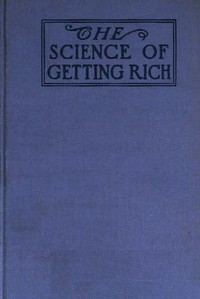
Self-improvementThe Science of Getting RichWallace D. WattlesTopFreeBooks
The Science of Getting Rich
Wallace D. Wattles · 1910
Why read it: The 1910 original: 17 short chapters on mindset, gratitude and daily action, free in the public-domain text.

Wallace D. Wattles' The Science of Getting Rich (1910) is a New Thought classic that still gets thousands of downloads a month on Project Gutenberg (8,890 in the 30 days before we checked), and its ideas on mental pictures and gratitude sound very like today's "manifesting" books. The good news: the original text is free and legal. Project Gutenberg has the 1910 edition with no signup. Below is where to get it, what each of its 17 short chapters says, the quotes worth keeping, and an honest look at which ideas are useful and which you should skip.
On 30 October 2026 we opened the Project Gutenberg page for the book (#59844), confirmed it is marked "Public domain in the USA" and lists EPUB, Kindle, HTML and plain-text files, checked the 1910 title page (Elizabeth Towne, Holyoke, Mass.; copyright April 1, 1910) in the Gutenberg text, and searched that text to check every quote and chapter title below.
Yes. The book was first published in 1910 by Elizabeth Towne in Holyoke, Massachusetts, and its US copyright has long expired. The copy on Project Gutenberg is marked "Public domain in the USA" and is free to read, download and share there. Wattles died in 1911, so the original text is also out of copyright in most countries that use a life-plus-70-years rule, but check your local law if you live outside the USA.
Be careful with modern editions. Many "Science of Getting Rich" paperbacks and PDFs add new introductions, workbooks or updated wording, and those new parts can be copyrighted. A PDF of a recent edition on a random file site is not a legal copy. Our book page, The Science of Getting Rich, links only to the free public-domain text.
Project Gutenberg does not offer a PDF of this book, but its other formats are better on a phone anyway: EPUB for Apple Books, Google Play Books and most e-readers; Kindle to send to a Kindle; HTML to read in a browser; and plain text if you want to copy quotes. If you really need a PDF, open the HTML version and use your browser's Print > Save as PDF.
It is a short book. At about 22,000 words it takes two to three hours, and each chapter is around ten minutes. Many readers go through it in a week, one or two chapters a night.
Wattles promises a method, which he calls acting and thinking "in a Certain Way", that he claims works like an exact science. His preface is blunt: "This book is pragmatical, not philosophical; a practical manual, not a treatise upon theories." The method has two halves. The first is mental: form a clear picture of what you want, hold it with faith and gratitude, and move "from the competitive to the creative mind", meaning you create new value instead of fighting others for a fixed pie. The second is practical: do everything you can in your current job or business every day, efficiently, and give every customer more value than they pay for.
The 17 chapters fall into four parts. The table gives the chapter titles exactly as printed in the 1910 edition.
| Chapters | Titles | What Wattles argues |
|---|---|---|
| I-III | The Right to Be Rich; There Is a Science of Getting Rich; Is Opportunity Monopolized? | Wanting money is not wrong, getting rich follows laws anyone can learn, and opportunity is never closed off: new industries keep opening. |
| IV-VIII | The First Principle in the Science of Getting Rich; Increasing Life; How Riches Come to You; Gratitude; Thinking in the Certain Way | The metaphysical core: a "thinking stuff" responds to clear mental images held with faith and gratitude. This is the part that sounds most like modern "manifesting". |
| IX-X | How to Use the Will; Further Use of the Will | Use willpower on yourself, not on other people: keep your attention on what you want and away from poverty, worry and gossip. |
| XI-XV | Acting in the Certain Way; Efficient Action; Getting into the Right Business; The Impression of Increase; The Advancing Man | The practical core: act now, where you are, do every task well, play to your strongest abilities, and leave every customer and colleague better off. |
| XVI-XVII | Some Cautions, and Concluding Observations; Summary of the Science of Getting Rich | Do not compete or cheat, do not dwell on the past, and a one-page summary of the whole method. |
1. Wanting more is not shameful. Chapter I says "There is nothing wrong in wanting to get rich." For readers raised to feel guilty about money, that permission is the book's first gift.
2. Create value, do not fight over it. Wattles tells readers to move "from the competitive to the creative mind". In plain terms: build, sell or improve something new rather than trying to take a bigger share of what others already have.
3. Give more than you take. Chapter XI says you "must give every man more in use value than he gives you in cash value". It is a good test for any job, side business or product: is the customer clearly better off?
4. Thought without action does nothing. The same chapter is clear: "By thought, the thing you want is brought to you; by action you receive it." Even Wattles warns against thinkers who fail "to connect thought with personal action."
5. Start today, where you are. Chapter XI says: "Act now. There is never any time but now, and there never will be any time but now." Chapter XII adds that you must "do ALL that you can do where you are." Waiting for the perfect job or business before you start is the most common way the plan fails.
Wattles promises far more than any book can deliver. His preface says that anyone who follows the method "will certainly get rich; for the science herein applied is an exact science, and failure is impossible." Nothing in personal finance is that certain, and the book offers no evidence beyond assertion.
Chapters IV to VIII rest on a "thinking stuff" that turns mental images into things. That is a religious and metaphysical claim from the New Thought movement of the early 1900s, not science, and readers will judge it by their own beliefs. Some economic examples have also aged badly: chapter III suggests leaving a factory job to buy "a farm of from ten to forty acres" and says such farmers "will certainly get rich".
Chapter IX also gives advice many readers will reject outright: "Do not spend your time in charitable work, or charity movements; all charity only tends to perpetuate the wretchedness it aims to eradicate." Wattles adds that he does not mean you should be "hard-hearted or unkind", but the advice still conflicts directly with zakat and sadaqah in Islam. Readers who give zakat or sadaqah can simply set this advice aside.
Read it as a motivational classic about attitude, gratitude and daily effort, and pair it with a practical money book for budgeting, saving and investing.
If you liked the mindset chapters, As a Man Thinketh by James Allen (1903) is the shortest classic on the same theme, and From Poverty to Power is Allen's longer take. If you liked the practical chapters, Acres of Diamonds by Russell H. Conwell argues that opportunity is usually close to home, Self-Help by Samuel Smiles is the Victorian classic on hard work, and Franklin's Way to Wealth is the original short guide to thrift and industry.
For a sharper look at what happens when crowds chase easy riches, read our Madness of Crowds summary, and for calm thinking about money and setbacks, our free Stoicism books list.
Wallace D. Wattles · 1910
Why read it: The 1910 original: 17 short chapters on mindset, gratitude and daily action, free in the public-domain text.

James Allen · 1903
Why read it: James Allen's 1903 essay on how thoughts shape character and circumstance; readable in an hour.
Russell H. Conwell
Why read it: Russell H. Conwell's famous lecture: the opportunity you are looking for is often where you already are.

James Allen · 1901, 1906 Science Press printing
Why read it: James Allen (1901) on self-discipline and inner change as the road out of poverty.
Book details · Read free at Internet Archive (library-digitised scan)

Samuel Smiles · 1859
Why read it: Samuel Smiles (1859): biographies of people who succeeded through effort and perseverance.

Benjamin Franklin · 1758
Why read it: Benjamin Franklin's 1758 classic on thrift and industry, as practical as Wattles is inspirational.
More on this topic: Self-improvement shelf.
Yes. The 1910 text is in the public domain in the USA, and Project Gutenberg (#59844) offers it free as EPUB, Kindle, HTML and plain text, with no signup. Wattles died in 1911, so it is also out of copyright in most life-plus-70 countries; check your local law.
Project Gutenberg does not offer a PDF, but you can open its HTML version and use Print > Save as PDF in your browser. Avoid PDFs of modern editions on file-sharing sites: their new introductions and notes can be copyrighted.
It is a 1910 New Thought book by Wallace D. Wattles. It argues that you get rich by holding a clear mental picture of what you want with faith and gratitude, and by acting efficiently every day while giving people more value than they pay for.
About two to three hours. It has 17 short chapters and roughly 22,000 words.
It belongs to the New Thought movement of the early 1900s (Project Gutenberg files it under that subject), the same tradition that modern law-of-attraction books come from. Its chapters on holding a mental image with faith and gratitude are the closest to that idea.
Its practical advice (create value, give more than you take, act now, do every task well) is sound. Its promise that "failure is impossible" and its metaphysical claims are not supported by evidence, so treat it as motivation, not a financial plan.
Read Marcus Aurelius, Seneca and Epictetus free and legally: 5 public-domain Stoic classics, which to start with, and where each free copy comes from.
Read Extraordinary Popular Delusions and the Madness of Crowds free and legally, plus a summary of the tulip, South Sea and Mississippi manias and 6 lessons.
Read Arnold Bennett's How to Live on 24 Hours a Day free and legally. Chapter summary, his 7.5-hour weekly plan, best quotes and what has aged.
See all posts →Every TopFreeBooks guide and reading list in one place.
General information only. Public-domain status is for the USA, so check your own country. We never host files; every link goes to the official source.