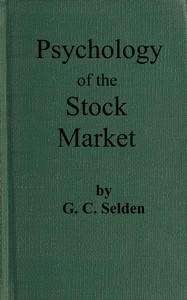
InvestingThe Psychology of the Stock MarketG. C. SeldenTopFreeBooks
The Psychology of the Stock Market
G. C. Selden · 1912
Why read it: The 1912 Gutenberg edition this summary quotes.


G. C. Selden published Psychology of the Stock Market in New York in 1912, and it is still one of the shortest, clearest books on why prices move more than the news seems to justify. Project Gutenberg released it free as ebook #75570 in March 2025, and TopFreeBooks lists it at The Psychology of the Stock Market. This guide maps all eight chapters, quotes lines checked word for word against the Gutenberg text, and turns Selden’s ideas into five habits you can use today. It is a book summary, not investment advice.
Every quotation in this guide was matched against the Project Gutenberg plain text of ebook #75570 (Ticker Publishing Company, 1912) with a script. Bibliographic details come from the Gutenberg ebook page (release date 9 March 2025, original publication United States: Ticker Publishing Company, 1912). Before choosing the book we read the full text for content that would be offensive to a Malaysian audience, such as racial, ethnic or religious slurs or hierarchies, eugenics or misogyny, and found none. Like most writing of 1912 it uses “he” for every trader, and it names Gilded Age financiers and firms of its day. This is a summary for readers, not financial advice.
Yes, in the United States. Psychology of the Stock Market on Project Gutenberg (ebook #75570) is offered with almost no restrictions on reuse, in EPUB, Kindle, HTML and plain-text formats. TopFreeBooks lists the same edition at The Psychology of the Stock Market, so you can open it without a signup wall or a “free PDF” site of unknown origin.
If you live outside the USA, check your local copyright rules before downloading. TopFreeBooks only lists editions we have verified as free to read.
Selden’s preface states his thesis in one sentence: the book “is based upon the belief that the movements of prices on the exchanges are dependent to a very large degree on the mental attitude of the investing and trading public.” He does not deny fundamentals. He says the broad moves “are always the result of general financial conditions”, but the smaller swings in between “represent changes in the state of the public mind”.
He also asks two questions that frame the whole book: how do the public’s moods move prices, and how does the trader’s own mood affect his chance of success? Most later books on behavioural finance return to those same two questions.
One line explains why crowds feel loud and still lose money: “Dollars are the horse-power of the markets—the mere number of men does not signify.” A thousand small traders talking bullishly can matter less than one quiet holder with capital who is selling to them.
The book is short enough to read in one sitting. Here is what you will find in each chapter.
| Chapter | What it covers |
|---|---|
| I. The Speculative Cycle | How a quiet market turns into a rally, a boom, distribution at the top and a slide back to dullness, over a week or over years |
| II. Inverted Reasoning and Its Consequences | Why professionals start to distrust the obvious, and why that habit is dangerous for beginners |
| III. “They” | The myth of a hidden “They” who move the market, and the three real things people mean by it |
| IV. Confusing the Present with the Future—Discounting | Why prices move before the news, and why buying after good news is often late |
| V. Confusing the Personal with the General | How your own position bends your judgment, and why fixed profit targets fail |
| VI. The Panic and the Boom | Fear, forced selling and liquid capital; how rising prices make people feel richer than they are |
| VII. The Psychology of Scale Orders | “Impulsive” versus “phlegmatic” buyers, support and pressure, accumulation and distribution |
| VIII. The Mental Attitude of the Individual | The temperament Selden recommends, with a five-point summary for active traders |
Chapter I walks through a full cycle. Prices rise “at first almost imperceptibly” while nobody cares. Shorts cover, a few shrewd buyers step in, and the public decides it will buy “on substantial reactions” that never come. Then the crowd concludes the market is “too strong to react much”, buys at any price, and the big holders quietly sell into that demand. When the load turns over, “the decline is usually more rapid than the previous advance.”
Selden’s summary is what makes the chapter memorable: the cycle is “a story of human hopes and fears”. He adds that the same pattern shows up whether the cycle takes a week, a month or a year. If you have read Reminiscences of a Stock Operator or The Cycles of Speculation, this is the same story told by an analyst rather than a trader.
On news: “Bear in mind that an item of news usually causes but one considerable movement of prices.” If the move came on rumours before the announcement, do not expect it to repeat after.
On “They”: Selden says the word “They” means nothing until you know who it refers to, and adds: “to use it continually without having any antecedent in mind is slipshod language, which stands for slipshod thinking.” When someone says ‘they are pushing it up’, ask who, exactly, and how they know.
On discounting: “Prices have risen to the extent represented by these increased earnings, unless this effect has been counterbalanced by other considerations. Now what next?” Good results are not a reason to buy if the price already reflects them.
On your own bias: “Likewise many seem to think that logic was given us for the purpose of backing up our desires.” Selden says the trader must forget his own position in the market and fix his thoughts on the position of the market.
On panics: “The great cause of loss in times of panic is the failure of the investor to keep enough of his capital in liquid form.” The lowest prices, he argues, come from forced sellers who have run out of cash, not from opinion.
1. Separate the market’s story from your position. Chapter V is the heart of the book: “The market is relentless. It cannot be budged by our sophistries.” Before deciding, ask what you would think if you owned nothing.
2. Distrust both extremes of sentiment. Selden notes that the market looks strongest near the top and hopeless near the bottom. He does not ask you to simply do the opposite of the crowd; he asks you to notice when enthusiasm or gloom is at its widest.
3. Keep cash for bad days. The panic chapter is a case for liquidity: people with “abundant property, but no ready money” are the ones forced to sell at the lows.
4. Treat rising prices with care. His grocer example shows how inflation makes a business feel richer: stock bought at $10,000 is valued at about $11,168 a year later, yet buys no more goods. Feeling rich is not the same as being rich.
5. Size small enough to stay calm. The closing summary says: “do not trade so heavily as to become anxious”, and “When in doubt, keep out of the market. Delays cost less than losses.”
Chapter VIII ends with a numbered list, paraphrased here: (1) keep the mind clear and balanced, do not act hastily on sensational information, do not trade so heavily that you worry, and do not let your position sway you; (2) act on your own judgment, or else entirely on someone else’s, not a mix; (3) when in doubt, stay out; (4) try to catch the trend of sentiment rather than fight it; (5) avoid being bullish at high prices and bearish at low prices.
He also asks for a particular kind of optimism: “Your optimism must be, in a sense, of the intellect, not of the will.” In other words, hope that you will read the tide well, not that the tide will obey you. And he warns against “getting a notion”, the habit of fixing on one factor and ignoring everything else.
The examples are from 1907–1912: Union Pacific, Reading and Steel, the Panic of 1907, the 1911 Standard Oil and American Tobacco decisions, fractional prices like 161⅛. Brokers’ offices, ticker tape and call money rates have given way to apps and algorithms, and the indicators Selden mentions for spotting the end of a boom (New York clearing-house bank deposits, call money rates) are period-specific.
Much of the book is also about margin trading and short selling. If you invest under Islamic principles, many investors avoid both; TopFreeBooks keeps a separate Islamic finance shelf. Read Selden for the psychology, which has not aged at all, rather than as a trading manual.
Content check: we screened the full text before recommending it. There are no racial, ethnic or religious slurs or hierarchies, no eugenics and no derogatory passages about women; the one dated habit is the period convention of calling every trader “he”.
For the trader’s view of the same cycle, read Reminiscences of a Stock Operator. For a 1926 companion on the same theme, try The Psychology of Speculation. For manias and bubbles across centuries, Extraordinary Popular Delusions and the Madness of Crowds, and for a calmer investor’s approach, How to Invest Money.
G. C. Selden · 1912
Why read it: The 1912 Gutenberg edition this summary quotes.
Edwin Lefèvre · 1923
Why read it: The same market psychology told as a trader’s story (1923).
Henry Howard Harper · 1926
Why read it: Henry Howard Harper’s 1926 book on speculative mistakes.

Thomas Gibson · 1907
Why read it: Thomas Gibson (1907) on recurring market cycles.

Charles Mackay · 1841
Why read it: Mackay’s classic on manias and bubbles.
George Garr Henry · 1908
Why read it: A plain 1908 guide to investing rather than speculating.
More on this topic: Investing shelf.
Yes in the USA. Project Gutenberg offers it as ebook #75570, public domain in the USA, in EPUB, Kindle, HTML and text formats. Check your local copyright rules if you are outside the USA.
It argues that short- and medium-term price swings depend largely on the mental attitude of traders and investors, and that a trader’s own hopes, fears and position are the biggest obstacles to clear judgment.
A preface and eight short chapters, roughly 18,000 words. Most readers finish it in one or two sittings.
Separate your view of the market from your own position, be suspicious of good news at high prices and bad news at low prices, keep enough cash to avoid forced selling, and trade small enough to stay calm.
The title page names him as the author of “Trade Cycles” and “What Makes the Market?”, and his preface says the book came from years as a fellow at Columbia University, news writer, statistician and editorial staff member of The Magazine of Wall Street.
The examples (1907 panic, ticker tape, railway stocks) are dated, but the psychology of hope, fear, crowd sentiment and self-deception is the same in today’s markets.
We read the full text before recommending it and found no racial, religious or ethnic slurs and no derogatory passages about women. It uses “he” for every trader, as was usual in 1912.

Read Extraordinary Popular Delusions and the Madness of Crowds free and legally, plus a summary of the tulip, South Sea and Mississippi manias and 6 lessons.
Read Reminiscences of a Stock Operator free and legally from Project Gutenberg, plus a plain-English summary, 8 key lessons and what to read next.

The Crowd by Gustave Le Bon (Gutenberg #445): free US ebook, chapter map, key quotes, and critical notes on race, gender and elite contempt.
See all posts →Every TopFreeBooks guide and reading list in one place.
General information only. Public-domain status is for the USA, so check your own country. We never host files; every link goes to the official source.